2. Economic markets arise from the interaction of supply-side and demand-side forces.
2.1: “Demand” can arise from either of man’s consciousnesses (1.4.2.1.1).
2.1.1: The primary source of Demand is the spirit’s desire for experiences that develop its consciousness (1.4.1, 1.5.1.3). This can be termed “non-materialistic demand”.
2.1.2: A subsidiary source of Demand is the desires arising in the human body as a result of material influences such as instinct, feeling, and imagination. This can be termed “materialistic demand”.
2.2: The urge to “Supply” can arise from either of man’s consciousnesses (1.4.2.1.1).
2.2.1: The primary instigator of Supply is non-material influences perceived by the spirit (1.5.1.3) which stimulate a material creative instinct (1.5.2.1.4) that seeks to manifest beauty in some way. This can be termed “non-materialistic supply”.
2.2.1.1: Non-materialistic supply is the spirit’s effort to translate a higher non-material reality into the material. It seeks to express beauty. It is self-expression independent of any desire for material reward. Art and the artist (true art; true artists) are the archetypal example, but the principle applies to every sphere of human endeavour. It is the expression of a creative urge.
2.2.1.2: It is possible for a material stimulus to prompt a non-materialistic supply urge (1.5.1.3). In this case a spiritually-aware human being comes across a material circumstance whose configuration is such that it can be used as a channel for spiritual self-expression.
2.2.2: A subsidiary source of supply is the desires arising in the human body as a result of material influences such as instinct, feeling, and imagination (1.5.2.1.3). This can be termed “materialistic supply”.
2.2.2.1: Materialistic supply arises from a physical impulse towards a material pleasure of some kind e.g. sustenance, money, power, fame.
2.3: The demand types and the supply types interact to produce 4 product/service archetypes:
- Materialistic Products: Materialistic Supply meeting Materialistic Demand;
- Bridge Products: Non-Materialistic Supply meeting Materialistic Demand;
- Idealistic Products: Non-Materialistic Supply meeting Non-Materialistic Demand;
- Proxy Markets: Materialistic Supply meeting Non-Materialistic Demand.
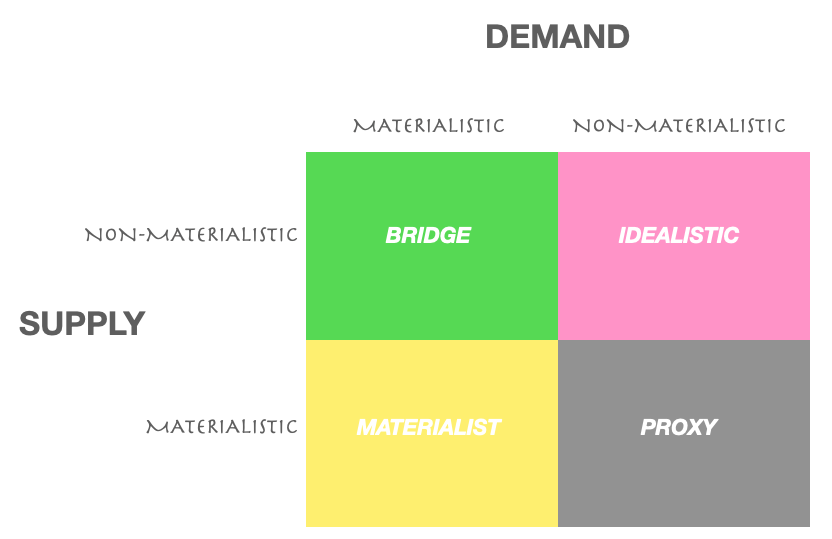
2.3.1: Materialistic Products are created by the efforts of entrepreneurs who are motivated primarily by material gain and who develop products and services to meet a materialistic demand. This is the concern of modern microeconomics.
2.3.2: Bridge Products are created by the efforts of entrepreneurs with a non-materialistic world view who seek to express a non-materialistic concept in a beautiful way through products and services of interest to a materialist mass market.
2.3.2.1: A simplified example of a Bridge Market: To the materialist, the need for home cooling may be considered a purely material-technical affair. A non-materialistic entrepreneur might be inspired by a vision of harmony between man’s built environment and the surrounding natural environment. He may choose to address the demand by helping homebuilders and architects make innovative design choices that would reduce the need for manufactured cooling devices. Being that the buyer (homebuilder, architect) is of a primarily materialist intent, the entrepreneur would need to “sell” his idea by appealing to materialist considerations (e.g. “better design would reduce the cost of cooling a home by XYZ dollars annually…”) even though these are not his primary motivation or interest.
2.3.2.2: The Materialistic Market and the Bridge Market share the same demand basis.
2.3.2.2.1: The Materialistic entrepreneur applies the principle that “the goal of the business is to satisfy the customer, not to educate him”.
2.3.2.2.2: The Non-Materialistic entrepreneur seeks to create something beautiful that can expand the spiritual consciousness of the customer in the process of satisfying him materially. He applies the principle that “the goal of the business is to (spiritually) educate the customer by satisfying him“.
2.3.2.3: Bridge Markets often give birth to Materialistic Markets (1.5.2.1.1). The market is initiated through the spiritualized insight of a non-materialistic visionary, and this stimulates the emergence of materialistic copycats.
2.3.3: Idealistic Products are created by the efforts of individuals who seek to express a non-materialistic concept through products and services of interest to similarly non-materialistic individuals.
2.3.3.1: Example of an Idealistic Market. A fan approached a music composer after a performance of one of his works and told him “The audience really enjoyed it!”, whereupon the composer replied “I would much prefer the audience understood it!”. Here the composer was seeking to impart a message, a non-material concept, to individuals seeking something more than just a pleasurable listening experience.
2.3.4: Proxy Products occur when materially-minded entrepreneurs offer products that purport to fulfill a primarily non-materialistic need.
2.3.4.1: Example of a Proxy Market. Many spiritually-aware individuals seek a non-material approach to healthcare. This gives rise to demand for certain “alternative” forms of therapy. On the other hand, many would-be suppliers of these therapies lack spiritual insight and are motivated by material gain. This gives rise either to fraud or to products and services of questionable efficacy – they are proxies for what the buyers actually want.
 Seeking Clarity
Leave a comment